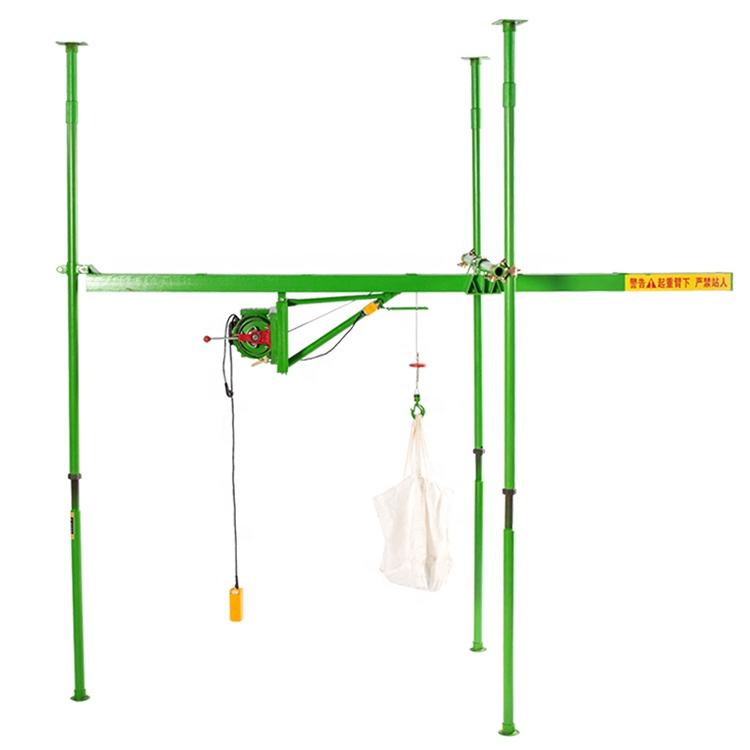


Cantilever crane, also known as jib crane or cantilever crane, you can think of it as a “robotic arm” fixed to a
pillar or wall. It can flexibly and efficiently transport cargo weighing tens of kilograms to several tons in a specific sector or circular area.
It is particularly suitable for short-distance and high-frequency hoisting, such as in workshop production lines,
machine tool loading and unloading, warehouse loading and unloading and other scenarios. It is more flexible
than large-scale vehicles and does not take up ground space.
Main composition
The structure of the cantilever crane is very clear and mainly consists of these three parts:
· Column: The “body” that supports the entire device, usually fixed to the ground or wall. · Spiral arm: A “
arm” that can be rotated, generally a metal structure, allowing the lifting range to cover a fan-shaped or circular area.
· Electric hoist: the “wrist” and “hand”
that move left and right on the spiral arm are responsible for the actual lifting and lowering of heavy objects.